Add Alias

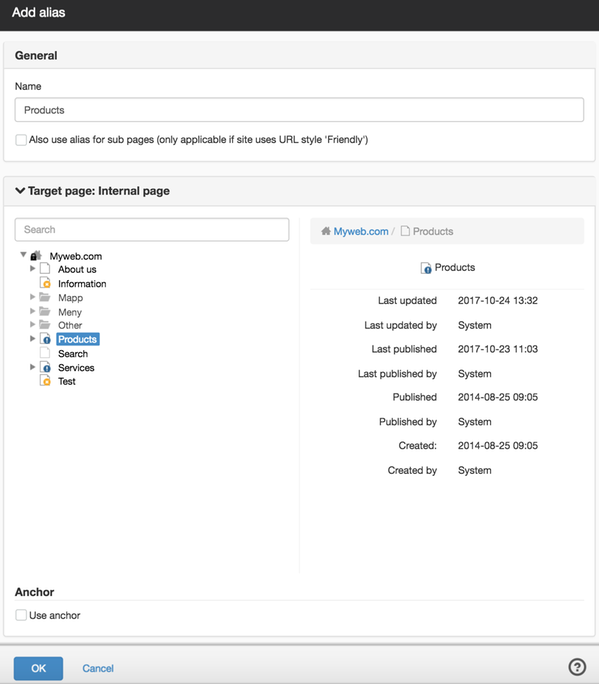
When you add an alias, you can customise how the address works and where it should lead. Here is an overview of all the settings.

General

Name

Here, you enter the alias itself – that is, the short address you want to create. Example: If you enter ‘contact’, the address will be: mysite.com/contact

If you use Å, Ä or Ö in aliases, some programmes (such as Microsoft Outlook) may display the addresses with unusual formatting, as they are re-encoded in the URL.

Permanent redirect (301)

If you are using a permanent alias, you should tick this box so that the redirect is a permanent redirect (301) rather than a temporary redirect (302).

A temporary redirect (302) remains on Google, whereas a permanent one (301) will be removed and replaced by the new address. A temporary redirect (302) carries less link equity with Google than a permanent redirect (301).

Prefix alias

A prefix alias means that all URLs starting with the prefix will trigger the alias. For example, if you set up “the campaign”, it will be triggered for:

The ‘normal’ URLs (i.e. works like a standard alias):<domain>/campaign

<domain>/campaign?foo=bar&baz=no

But also URLs that have the alias’s prefix:<domain>/campaign/

<domain>/campaign/product1

<domain>/campaign/product1/stock1

Technically speaking, a prefix alias will never work if it begins or ends with / Sitevision’s automatically generated canonical URL is not suitable for use if you are using prefix aliases.

The page to which the prefix alias points must have functionality (presumably a web app) that displays different content depending on the URL.

Target page:internal page

If you select Tareget page: Internal page the structure appears on the website. Locate the contact page and select it. Click OK. Done!

Instead of entering the full path or looking in menus, the visitor can now enter minwebb.se/contact to easily get to the contact page.

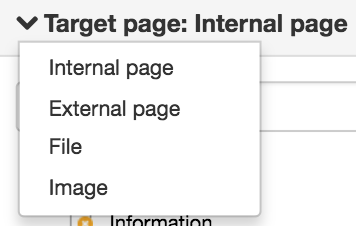
You can also create aliases for external pages, images and files. Select a different type by clicking on Target page:Internal page:

To delete an alias, select it from the list and click the cross on the right. To change an alias, double-click on the alias in the list, or click the Change alias icon on the right.

This function requires you to have "Manage website settings" permission

The page published:

Did the information help you?

help.sitevision.se always refers to the latest version of Sitevision